

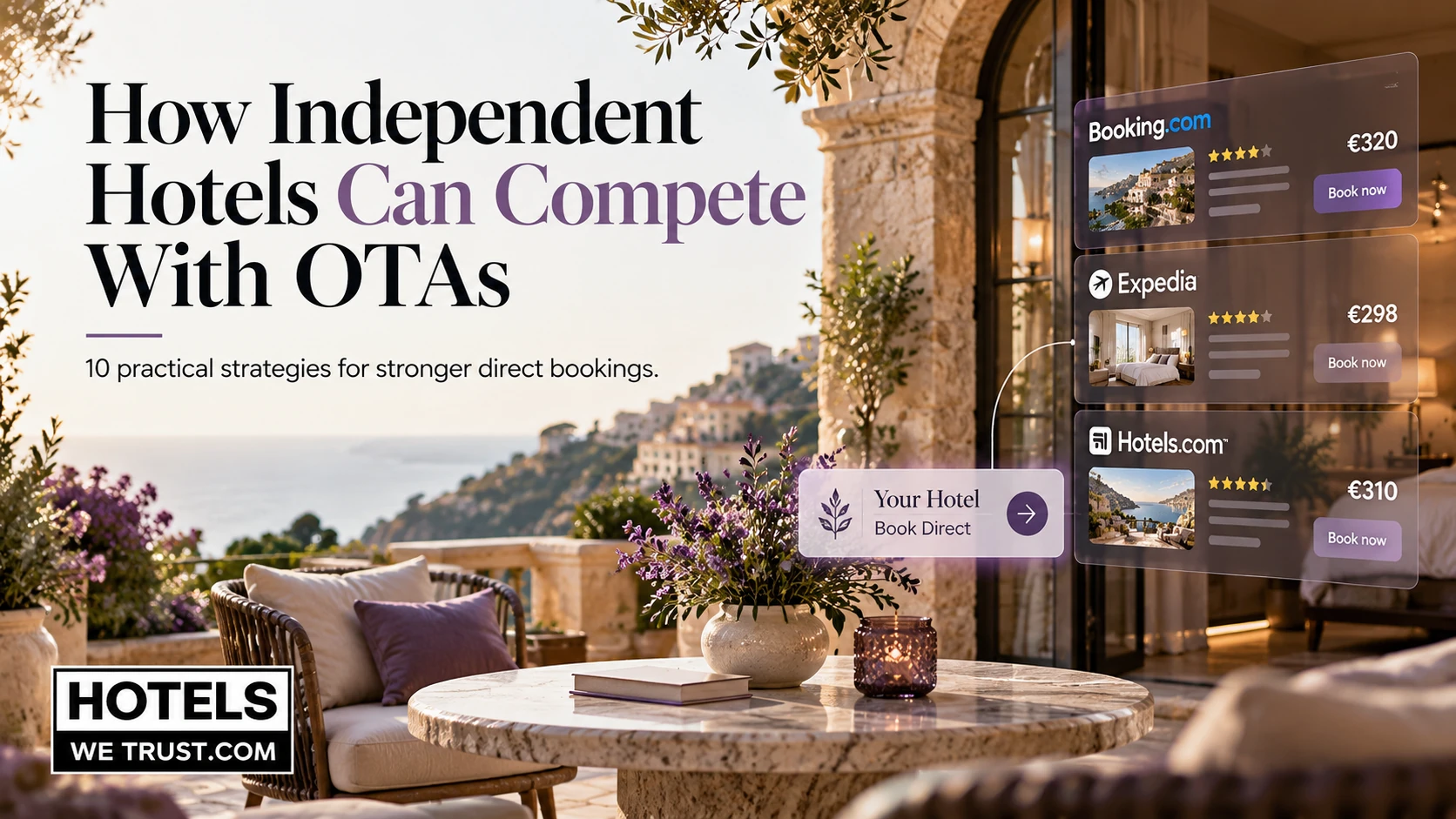

10 practical strategies to increase direct bookings, strengthen hotel visibility and build a more independent future.
Online travel agencies have transformed hotel distribution. But for independent hotels, visibility should not come at the cost of losing control over their guest relationships.
Booking.com, Expedia and other online travel agencies (OTAs) offer something independent hotels often struggle to achieve alone: enormous global visibility, established consumer trust and sophisticated booking technology.
For smaller hotels, boutique properties and independently operated resorts, these platforms can be valuable sources of demand.
The challenge begins when an OTA becomes not simply a distribution partner, but the primary way travellers discover, evaluate and book a property.
Higher distribution costs, limited control over customer relationships and growing competition for attention can make independent hotels increasingly dependent on intermediaries.
The solution is not necessarily to abandon OTAs.
It is to build a stronger independent presence alongside them.
Here are ten practical strategies that can help independent hotels compete more effectively, attract travellers directly and develop a more sustainable distribution model.
1. Understand the Real Cost of OTA Dependency
OTA commissions are only one component of hotel distribution costs.
When evaluating booking channels, hotels should also consider promotional discounts, preferred-placement programmes, payment processing costs, cancellation patterns and the resources required to manage each channel.
Two reservations with identical room rates can produce different net contributions.
Consider a simplified example:
A guest books a €200 stay through an OTA charging an illustrative 18% commission. The hotel pays €36 in commission, leaving €164 before other operating expenses.
A direct reservation for the same €200 stay does not incur that OTA commission, although it may involve booking engine, payment processing and marketing costs.
This distinction matters.
The objective should not simply be to increase gross booking revenue, but to understand how much each channel contributes after its associated acquisition and distribution costs.
Independent hotels should monitor:
- OTA commission and promotional costs
- Direct booking acquisition costs
- Net revenue by distribution channel
- Cancellation rates and booking lead times
- Repeat guest and direct booking rates
A balanced distribution strategy starts with knowing the economics of each booking source.
2. Turn the Hotel Website Into a Booking Channel, Not Just a Brochure
Many independent hotels invest heavily in photography, architecture and interior design while overlooking the effectiveness of their website.
A beautiful website is important. But visual appeal alone does not generate reservations.
A hotel website should help travellers answer four questions quickly:
Is this the right property for me? Can I trust it? What will my stay cost? How easily can I book?
Successful hotel websites typically combine strong presentation with straightforward functionality.
Essential features include:
- Fast loading speeds, particularly on mobile devices
- Clear room descriptions and high-quality photography
- Transparent rates, taxes and booking conditions
- A visible Book Direct button
- Secure, mobile-friendly reservation technology
- Clear cancellation and payment policies
- Accurate contact details and location information
The booking journey should also remain consistent between the hotel’s website and its reservation engine. Our article A Book Direct Button Is Not a Strategy explains why the button alone cannot replace a complete direct booking strategy.
An elegant homepage followed by a confusing, outdated or poorly translated booking interface can undermine traveller confidence.
The strongest hotel website is not necessarily the most elaborate. It is the one that makes choosing and booking the property feel effortless.
3. Give Travellers a Genuine Reason to Book Direct
Independent hotels cannot always compete with the advertising budgets of global booking platforms.
But they can compete through relevance, flexibility and personal service.
A direct booking benefit should provide an understandable advantage without unnecessarily reducing the room rate.
Depending on the property’s operations and commercial strategy, useful benefits might include:
- Complimentary parking
- Flexible check-in arrangements, subject to availability
- A welcome drink or locally sourced gift
- A room upgrade when available
- Exclusive packages or experiences
- Greater flexibility when modifying a reservation
- Direct communication with the property before arrival
These benefits should be genuine, clearly described and consistently delivered.
Hotels must also consider applicable rate-parity obligations, contractual restrictions and local competition rules when designing direct booking offers.
The objective is not to create artificial incentives.
It is to communicate the additional value of dealing directly with the property.
A compelling direct booking proposition answers one simple question: Why should a guest book here instead of through an intermediary?
4. Strengthen Visibility Beyond Booking Platforms
One of the greatest challenges for independent hotels is discovery.
A property may offer exceptional accommodation but remain difficult to find unless travellers already know its name.
This is where a broader digital visibility strategy becomes essential.
Hotel discovery increasingly happens across several environments, including Google Search, Google Maps, Google Hotels, social media, editorial travel publications and AI-assisted search experiences.
Independent hotels should avoid concentrating all discovery efforts on a single platform.
Practical opportunities include:
Google Business Profile: Maintain accurate photographs, amenities, contact information and official website links.
Google Hotels and metasearch: Explore connectivity that allows travellers to compare rates and access the hotel’s official booking channel.
Search engine optimisation: Develop useful destination pages, room information and content addressing real traveller questions.
Independent hotel collections: Participate in relevant curated platforms that introduce travellers to distinctive properties and encourage visits to their official websites.
Editorial visibility: Seek credible coverage through destination guides, independent hospitality publications and relevant travel content.
The objective is to become discoverable through multiple trusted sources.
More discovery channels can create more opportunities for travellers to reach the hotel directly.
5. Compete Through Identity, Not Inventory
Large booking platforms allow travellers to compare thousands of properties.
That convenience is valuable, but it can also reduce distinctive hotels to a familiar combination of price, location, rating and availability.
Independent hotels have an opportunity to communicate something that is difficult to capture in a search filter: their identity.
A restored historic residence, a family-run countryside hotel, an architect-designed retreat or a small coastal property may offer an experience that cannot be adequately explained by its star classification.
Hotels should communicate what makes them different:
- The story behind the property
- Its relationship with the surrounding destination
- Architectural and interior design details
- Local culture, cuisine and experiences
- The people behind the hospitality
- The type of traveller the property is best suited to welcome
This does not require exaggerated luxury claims or overly promotional language.
Specific, credible details are more persuasive than generic descriptions.
Instead of calling a hotel a unique luxury escape, explain what actually distinguishes it.
An independent hotel’s greatest competitive advantage may be the very thing that makes it difficult to standardise.
6. Build Guest Relationships That Last Beyond Checkout
OTAs are effective at introducing travellers to accommodation options.
But the hotel itself is responsible for delivering the experience.
That creates an important opportunity.
A guest who originally books through an OTA can still become a loyal returning customer who chooses to book directly on a future visit.
This requires more than asking guests to use the official website.
Hotels should focus on creating reasons to return.
These may include personalised pre-arrival communication, thoughtful service, relevant post-stay messages and clear information about future booking options.
Where permitted and with appropriate consent, hotels can maintain direct guest communication through email and other channels.
A useful post-stay message might thank guests for visiting, invite feedback and explain how to contact the property directly for future reservations.
The long-term value of a guest relationship extends beyond an individual booking.
It can include repeat visits, referrals, longer stays and stronger brand recognition.
An OTA may introduce the guest. The hotel has the opportunity to build the relationship.
7. Use Content and SEO to Capture Traveller Intent
Search engine optimisation for independent hotels should go beyond targeting the hotel’s own name.
Travellers often begin with questions about destinations, experiences and accommodation types.
For example:
- Where should I stay for a weekend in Dubrovnik?
- What are the best small hotels near Prague?
- Which hotels offer direct booking benefits?
- Where can I find a quiet countryside retreat in Europe?
A hotel that publishes genuinely useful content related to its destination can potentially reach travellers before they have selected a particular property.
Effective content may include neighbourhood guides, seasonal travel advice, local restaurant recommendations, cultural attractions, practical arrival information and suggested itineraries.
Each article should serve a clear traveller need.
Avoid publishing repetitive destination content that provides little beyond information already widely available.
For SEO, focus on descriptive headings, accessible page structure, internal links, accurate metadata, useful images and original information.
For emerging AI-powered search experiences, clarity and verifiability are particularly valuable.
Explain what the property offers, where it is located, who it suits and what distinguishes it from alternatives.
Include accurate, relevant information that can be independently checked.
There is no guaranteed method for securing a recommendation from Google AI Overviews, ChatGPT or other AI search systems.
However, useful content, clear factual information and credible references can make a hotel or publication easier for search technologies to understand.
A strong hotel SEO strategy begins with useful answers, not repeated keywords.
8. Make Trust a Competitive Advantage
Trust influences hotel selection, especially when travellers are unfamiliar with a property or destination.
Large travel platforms have developed extensive review systems and established booking processes that help reduce perceived risk.
Independent hotels need to build confidence through their own channels.
Important trust signals include:
- Authentic and consistent photography
- Recent, credible guest reviews
- Clear booking and cancellation conditions
- Secure payment processes
- Accurate property and contact information
- Responsive guest communication
- Transparent descriptions of facilities and limitations
Independent evaluations and credible third-party references can provide additional context when their methodology and claims are clear.
Trust should also extend to the booking experience. For a practical guest-centred checklist, read The Direct Booking Experience: What Guests Actually Expect.
If the official hotel website feels less reliable than an OTA listing, travellers may choose the intermediary even when they would prefer to book directly.
The objective is to make the hotel’s official channel at least as reassuring and straightforward as the alternatives.
9. Measure Progress Beyond Occupancy
Occupancy remains an essential operational metric, but it cannot explain the complete performance of a hotel’s distribution strategy.
A property may achieve strong occupancy while experiencing declining profitability due to acquisition costs.
Independent hotels should monitor the quality and economics of their booking channels.
Useful performance indicators include:
Direct Booking Share: The proportion of reservations or room nights generated through direct channels, using a consistent definition.
Net Revenue by Channel: Revenue remaining after applicable distribution and acquisition costs.
Website Booking Conversion Rate: The proportion of eligible website visits that result in confirmed reservations.
Booking Engine Abandonment: The proportion of booking sessions that begin but do not result in a completed reservation.
Repeat Guest Rate: The proportion of returning guests over a defined reporting period.
Website and Booking Engine Clicks: Indicators of whether external visibility is generating interest in the hotel’s own booking channels.
Hotels should review these metrics over time rather than interpreting isolated figures.
An increase in direct booking share is encouraging, but it should be assessed alongside occupancy, average daily rate, net revenue and total demand.
The goal is not simply to shift reservations from one channel to another.
It is to develop a healthier and more profitable channel mix.
10. Collaborate to Build Independent Visibility
One of the structural advantages of OTAs is scale.
Their extensive property inventories, marketing infrastructure and brand recognition allow them to reach travellers across multiple markets.
Individual independent hotels rarely possess comparable resources.
But independence does not have to mean isolation.
Collaboration creates opportunities to improve visibility while preserving each property’s own identity and commercial autonomy.
Relevant partnerships can include regional tourism initiatives, local experience providers, destination publishers and carefully curated hotel collections.
Such relationships can help properties reach audiences beyond their existing networks.
This principle is central to HOTELS WE TRUST.
Rather than operating as another commission-based booking intermediary, HOTELS WE TRUST focuses on the independent discovery of selected properties and encourages travellers to continue to each hotel’s official website and booking engine.
Hotels retain their booking process and guest relationship.
The purpose is to contribute to a stronger discovery environment for quality independent hospitality, without replacing the hotel’s own booking channel.
As a collection develops, participating properties can benefit from a shared focus on editorial visibility, destination discovery and direct booking awareness.
This is a long-term visibility approach, with no guarantee of bookings, traffic or revenue.
Independent hotels do not need to become identical to compete. Their individuality is precisely what makes collective discovery valuable.
What the Latest Hotel Distribution Data Reveals
Recent industry research reinforces the importance of a balanced distribution strategy.
HOTREC’s European Hotel Distribution Study 2026, published on 15 September 2026, covers the reference year 2025 and draws on information from 2,713 hotels. It reports the following channel shares. Direct channels include hotels’ own booking channels and should not be interpreted as website bookings alone.
The 85.4% figure below refers to the two groups’ share of OTA bookings, rather than their share of all hotel bookings.
These results show that direct distribution remains significant alongside a highly concentrated OTA market.
SiteMinder’s Hotel Booking Trends analysis of 2025 reservations recorded higher average booking value through hotel websites than OTAs. These are values per reservation, not nightly rates or profit margins; SiteMinder’s global dataset differs from HOTREC’s European survey.
| Measure | Reported result |
|---|---|
| Hotel bookings through direct channels, HOTREC | 51.3% |
| Hotel bookings through OTAs, HOTREC | 29.9% |
| Booking Holdings and Expedia Group share of OTA bookings, HOTREC | 85.4% |
| Average reservation value through hotel websites, SiteMinder | Approximately €461 (US$516) |
| Average reservation value through OTAs, SiteMinder | Approximately €279 (US$312) |
Currency conversion: approximate euro equivalents use the European Central Bank reference rate of 26 October 2026, €1 = US$1.1188, rounded to the nearest euro. SiteMinder reports the original figures in US dollars; the euro amounts are HWT’s illustrative conversions, not historical 2025 euro averages.
These figures do not mean direct bookings are automatically more profitable in every situation. Differences in room categories, booking values, guest characteristics and acquisition costs matter.
They do, however, highlight the commercial importance of maintaining a competitive direct booking channel.
Sources: HOTREC, European Hotel Distribution Study 2026 and SiteMinder, Hotel Booking Trends.
A Practical 90-Day Action Plan for Independent Hotels
Improving direct bookings does not always require a major technology investment or a complete marketing overhaul.
A focused 90-day programme can provide a useful starting point.
| Period | Priority | Practical output |
|---|---|---|
| Days 1–30 | Audit the foundations | Review mobile usability, booking engine functionality, cancellation policies and channel costs. Record the main obstacles to direct bookings. |
| Days 31–60 | Strengthen the direct offer | Improve room information, photography and calls to action. Define deliverable booking benefits and update Google Business Profile. |
| Days 61–90 | Expand visibility and measure | Assess editorial, collection and metasearch opportunities. Review website visits, engine activity, direct reservation share and acquisition costs. |
Not every strategy will suit every property. The strongest approach depends on market positioning, destination, existing demand, technological capabilities and available resources.
Consistency matters more than attempting everything simultaneously.
Frequently Asked Questions
Can independent hotels compete with Booking.com and Expedia?
Yes. Independent hotels can compete for direct reservations by improving their websites, strengthening their identity, offering genuine direct booking benefits and developing their own visibility channels. The objective is not necessarily to replace OTAs, but to avoid excessive dependency on them.
Is direct booking always cheaper for hotels?
Not always. Direct bookings avoid OTA commissions but may still involve advertising, booking technology, payment processing and other acquisition costs. Hotels should compare net revenue and acquisition costs across channels.
How can a small hotel increase direct bookings without a large marketing budget?
Start with a reliable mobile website, a simple booking engine, accurate Google Business Profile information, clear booking conditions and compelling property descriptions. Local partnerships, destination content and returning guests can also support direct demand.
Should independent hotels stop using OTAs?
For most independent properties, a balanced distribution strategy is more practical. OTAs can provide access to new markets and travellers, while direct channels can help hotels strengthen guest relationships and improve control over distribution.
What makes travellers book directly with a hotel?
Common reasons include trust in the official website, clear rates and conditions, a convenient booking process, personal communication and genuinely useful direct booking benefits.
How can independent hotels become more visible in AI search?
Hotels should publish accurate, accessible and useful information about their location, facilities, room types, policies and distinctive experiences. Consistent information across their official website and credible third-party sources can also help search systems interpret the property. No technique guarantees inclusion in AI-generated answers.
The Future of Independent Hospitality Is Not About Rejecting OTAs
OTAs will remain important components of hotel distribution.
Their technology, marketing reach and established consumer relationships provide substantial value to the hospitality industry.
But independent hotels should not measure their competitive position solely by their visibility on intermediary platforms.
Long-term resilience comes from building a recognisable identity, a trustworthy direct booking experience, diversified visibility and stronger relationships with guests.
Every improvement that makes an independent hotel easier to discover, understand and book directly contributes to that goal.
The future of independent hospitality is not about eliminating intermediaries. It is about ensuring that hotels remain visible, commercially resilient and in control of their own guest relationships.
At HOTELS WE TRUST, we believe exceptional independent hotels deserve to be discovered for the quality and individuality of their hospitality.
Our mission is to connect travellers with carefully selected independent stays and encourage direct access to the properties themselves.
Better discovery can help independent hotels build stronger direct relationships with travellers.
Explore independently selected stays. Discover the difference. Book directly at the source.