

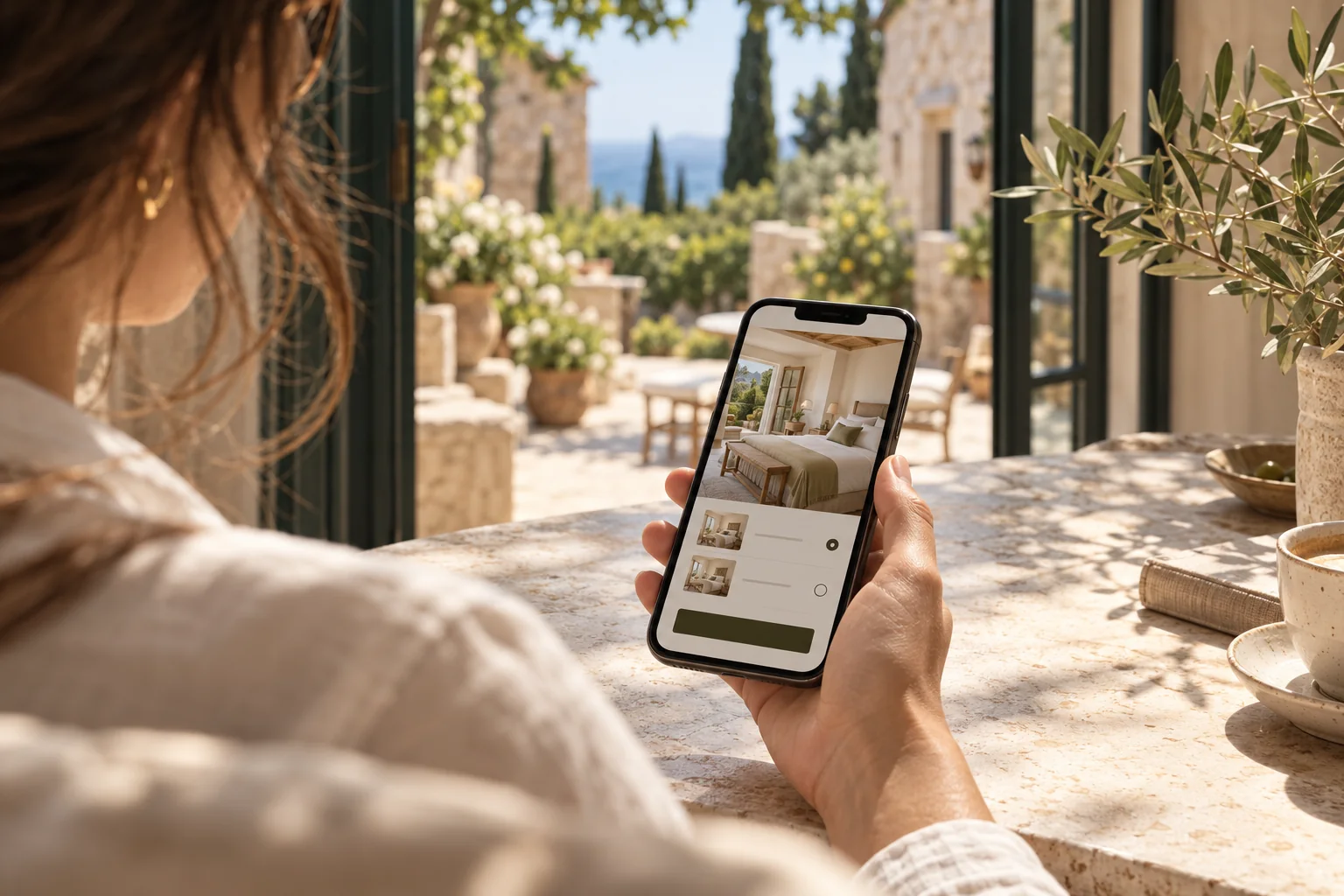

A guest finds a hotel they love. The rooms look inviting, the location works, and the dates are available. Before they reserve, a few questions remain: Which room am I actually getting? What will I pay today? Can I change my plans? Who will help if something goes wrong?
The direct booking experience is the complete journey through those questions, from the hotel’s website to the booking confirmation and the support that follows. For independent hotels, this is where the promise of personal hospitality becomes something a guest can judge.
Guests may understand that booking directly benefits the property. Their decision still depends on whether it benefits them. They need a fair offer, enough information to choose confidently and a reservation process they can trust.
For hotel owners, General Managers and commercial teams, the most useful starting point is to read the journey through the guest’s eyes.
1. “Show me whether this stay will work for me”
Beautiful photography earns attention. Specific information helps a guest decide.
A couple arriving late needs to understand check-in arrangements. A parent needs to know whether a child can sleep in the selected room and what the extra bed costs. A guest with reduced mobility needs details about the route to the room, bathroom layout and relevant access limitations.
Those questions should be answered where the decision happens. If parking requires advance reservation, explain that beside the parking information. If the restaurant closes on certain evenings, make that visible before a guest books a dining package.
Room descriptions deserve particular care. Explain bed configuration, room size, outlook, bathroom features and meaningful differences between categories. Identify photographs of representative rooms when layouts or views vary. A picture of the property’s best terrace should not imply that every room includes it.
Useful detail lets guests select a room that suits their stay. It also gives reservations staff fewer misunderstandings to resolve later.
2. “Let me understand the price without doing the maths”
A low nightly rate attracts little confidence if the stay total remains unclear.
Show the selected dates, occupancy, currency and total for the stay together. Explain included services and any mandatory charges, distinguishing amounts collected online from amounts payable at the property. If a charge depends on guest circumstances, explain how it is calculated.
Consider this fictional two-night offer:
Two nights, two adults: €420 total, including breakfast and applicable taxes. Pay €84 today and €336 at check-in. Parking is optional at €15 per night.
The usefulness comes from the relationship between those figures. The guest can understand the commitment before entering payment details.
This is an established usability concern. Baymard’s January 2026 travel-accommodation benchmark identifies transparent pricing and decision support among areas where booking websites and apps continue to fall short.
When comparing a direct offer with an OTA, use the same room, dates, occupancy, inclusions and cancellation terms. A cheaper non-refundable rate does not answer whether the hotel offers better value than a flexible alternative.
3. “Help me choose a rate I understand”
Guests should be able to explain the difference between the rates they see.
“Flexible”, “Advance Purchase” and “Exclusive Offer” are labels. They need accompanying answers: when payment is taken, whether a deposit is refundable, the cancellation deadline and what happens after that deadline.
Put a short, readable policy summary beside each rate. Give exact dates and times, including the relevant time zone, once the stay dates are selected. Explain no-show conditions and whether changes are possible. Keep the full terms available for guests who need them.
Expedia Group’s 2025 hotel research, drawn from a survey of 11,000 consumers across 11 markets, places price, positive reviews, refundability and flexibility among hotel booking priorities. It offers context for the importance of these questions, rather than a universal ranking for every property’s guests.
A restrictive rate can still be a suitable choice. The guest needs to understand the trade-off before committing.
4. “Give me a reason to book here”
The direct offer should be easy to find and easy to describe.
A price advantage may be persuasive. So may included breakfast, reserved parking, a useful cancellation option or access to a room category available directly. The right benefit depends on the property and the people it wants to attract.
Make the benefit concrete. “More when you book direct” leaves the guest guessing. “Breakfast for two included with this rate” explains what they will receive.
Be equally precise about conditional benefits. A late check-out subject to availability should not appear as a guaranteed inclusion. If a benefit applies only to certain rates or dates, show those limits with the offer.
The test is simple: can a guest explain why this particular reservation is worth making on the hotel’s website? Our article on building a hotel direct booking strategy explores the wider commercial decisions behind that proposition.
5. “Keep the booking easy on my phone”
A mobile booking journey needs to work under ordinary conditions: a small screen, interruptions and a guest who may need to check dates with someone else.
Preserve selected dates and occupancy when the guest opens a room description or goes back a step. Make it possible to edit a detail without rebuilding the reservation. Keep the chosen room, rate and total visible at the point of commitment.
Use forms that support autofill and appropriate keyboards. Explain errors beside the relevant field and retain valid entries when something needs correcting. Where the booking system allows it, let guests reserve without creating an account.
Check the transition into the booking engine as carefully as the homepage. A different domain can work, provided the property remains clearly identified and the guest recognises the room and offer they selected.
Test on actual phones. Include the date picker, consent banner, room comparison, payment authentication and the return from the payment provider. A booking journey is only as reliable as the steps a guest must complete.
6. “Make it clear what happened to my payment”
Entering card details is a moment of commitment. An unclear result leaves a guest with an urgent question: have I booked, or have I only been charged?
Before payment, explain whether the hotel will take a deposit, collect the full amount, request a card guarantee or place a pre-authorisation. These arrangements have different implications for the guest.
After payment, show a clear reservation status. If processing is still underway, say so. If an attempt fails, give a useful next step and a contact route. Avoid language that encourages repeated payment attempts when the outcome is uncertain.
Hotels should agree a recovery process with their booking and payment providers. Staff need a way to investigate a guest’s report without asking them to send complete card details by email or ordinary messaging.
Payment methods should reflect the hotel’s markets and technical capabilities. Whatever methods are offered, guests need to understand what they are authorising and how to obtain help.
7. “Confirm the details and help me manage the stay”
The booking experience continues after the online checkout.
A useful confirmation brings together the reservation reference, dates, occupancy, room, inclusions, total price, payment schedule and cancellation conditions. Include the property address and a clear route for questions or changes.
Repeat any direct-booking benefit accurately. Explain whether a request, such as a particular bed arrangement or arrival time, is confirmed or awaiting a response. A request recorded in the system is not automatically a promise the hotel can fulfil.
If guests can manage their booking online, make that link easy to find. Where changes require staff assistance, explain how to contact the team and give realistic service hours. Distinguish cancelling a reservation from the timing of any refund due.
Pre-arrival communication should then help guests prepare: directions, parking access, late-arrival instructions or whether dinner needs reserving. Keep optional upgrades secondary to the information needed for a comfortable arrival.
A practical direct booking audit for hotel teams
Ask someone unfamiliar with the booking system to attempt a realistic reservation on their phone. Observe where they hesitate, what they misunderstand and which questions send them looking elsewhere.
Use scenarios that expose different decisions:
| Guest scenario | What the team should check |
|---|---|
| Two adults comparing room categories | Can they identify meaningful differences and the total price? |
| A family booking with a child | Are occupancy rules, bed arrangements and supplements clear? |
| A guest arriving after reception closes | Can they confirm the arrival process before paying? |
| A search with no matching availability | Are alternative dates or a useful enquiry route offered? |
| A payment interruption | Is the reservation status clear, with a reliable way to get help? |
| A confirmed guest changing plans | Can they find their conditions and request or make a change? |
Use an agreed test environment or a controlled staff procedure for payment and cancellation checks. Record the obstacle, the action needed and who will resolve it. Repeat the affected journey after the fix.
Measure completed reservations alongside cancellation patterns and recurring support questions. If guests regularly ask whether breakfast is included or when a deposit will be taken, the booking journey is leaving important work unfinished.
Make confidence part of the service
The direct booking experience gives guests an early indication of how a hotel communicates and cares for them. Clear room information sets expectations. Understandable terms support a considered decision. Reliable confirmation and accessible help show that the property is ready to take responsibility for the reservation.
HOTELS WE TRUST helps travellers discover carefully selected independent stays and reach each property’s own website and booking channels. Once they arrive there, the hotel has an opportunity to turn interest into the beginning of a guest relationship.
For owners and commercial teams, the priority is practical: identify the questions guests cannot answer, remove the uncertainty and make the next step easy to understand. That is how the hotel’s hospitality starts to become visible before arrival.
Learn more about HOTELS WE TRUST for properties.
Frequently asked questions
What is the direct booking experience?
It is the journey a guest takes when reserving through a hotel’s own channels, including evaluating rooms and rates, understanding conditions, completing payment, receiving confirmation and managing the reservation.
What information should a hotel show before a guest pays?
Show the selected stay and room, occupancy, total cost, inclusions, payment timing, cancellation conditions and any mandatory charges payable later. Make conditional benefits and unconfirmed requests clear.
How can a hotel improve its mobile booking experience?
Test complete guest scenarios on real phones. Prioritise readable room and rate details, usable date selection, short forms, preserved booking choices and clear outcomes after payment or errors.
Does a good direct booking experience require the lowest price?
A competitive total price matters, but guests also assess flexibility, useful inclusions, convenience and support. The direct offer needs a clear advantage that the property can deliver consistently.